
Trade Show Branding in Asia: How Exhibitors Earn Buyer Trust Beyond the Booth Design
Walk the floor of any major trade fair in Kuala Lumpur, Bangkok, Singapore or Guangzhou and read the booth headers. “Leading manufacturer.” “Trusted partner.” “Innovative solutions.” “Premium quality.” After the first hall, the words stop registering. After the second, a buyer starts to assume that everyone says the same thing because nobody can prove anything different.
This is the quiet problem of trade show branding in Asia. Companies spend heavily on space, construction, travel and staffing, then fill the booth with claims a visitor has already read forty times that morning. The design may be striking, but design attracts attention. It does not create belief.
The exhibitors who convert visitors into serious enquiries usually do something less visible. They make their claims easy to check. This article sets out how.
Why Exhibition Halls in Asia Magnify the Credibility Problem
Asia-Pacific is now the largest exhibition region in the world by venue space. UFI’s 2025 World Map of Exhibition Venues found that the region accounts for more than 38% of global indoor exhibition capacity, ahead of Europe for the second year in a row. More halls and bigger venues mean more exhibitors competing for the same few hours of a buyer’s attention.
Those buyers do not come to browse. Research from the Center for Exhibition Industry Research (CEIR) found that 69% of attendees came to shop for new products. A separate CEIR report found that senior executives, more than other visitors, want to find solutions to existing problems and meet actual users of a product. In other words, the people with buying authority arrive in evaluation mode.
Trust has also become a more explicit buying criterion. Edelman’s 2025 brand trust research reports that trust now sits alongside price and quality as a purchase consideration. That study looked at consumers, but the logic carries into B2B settings, where the cost of choosing the wrong supplier is usually far higher.
Put together, the picture is clear. Asian exhibitors face more competition, more evaluative buyers and more scrutiny of claims. A booth that only asserts will lose to a booth that demonstrates.
The Three Moments Where Trade Show Credibility Is Won or Lost
It helps to think of an exhibition not as a single encounter but as three distinct moments. Each one demands a different kind of proof.
1. The Aisle Glance
A buyer walking the aisle gives each booth a few seconds. In that window, the booth has to answer one question: is this company worth stopping for? Vague adjectives fail here because they are indistinguishable from the neighbours. What works is a single specific, verifiable fact. Examples include the number of export markets served, a named industry standard the product meets, years of continuous operation, or a recognised achievement with an identifiable source.
2. The Booth Conversation
Once a visitor stops, the burden shifts from attention to substance. This is where senior buyers want to see the product working, understand which problem it solves and hear from comparable customers. Sales staff need ready access to evidence: case summaries, reference customers who have agreed to be named, test results and certificates. Staff who can only repeat the brochure lose serious buyers quickly.
3. The Follow-Up Desk Review
The most important moment happens after the show, often without the exhibitor present. Back at the office, a buyer sorts a stack of business cards and brochures and decides which suppliers to contact. Many will search the company online, compare claims with the website and check whether any recognition displayed at the booth can actually be found. Companies that have prepared for this kind of buyer due diligence survive the shortlist. Companies whose booth claims cannot be traced do not.
Turning Booth Claims Into Checkable Proof
The most practical exercise before any exhibition is to audit every claim that will appear on the booth, in the brochure and in staff talking points. Then pair each claim with the proof that supports it. The table below shows how common booth claims can be rewritten.
| Typical Booth Claim | Why Buyers Discount It | Checkable Alternative | Proof to Have on Hand |
|---|---|---|---|
| Leading manufacturer | Every competitor says it | A specific, measured fact about scale or output | Audited figures or a published, independently assessed achievement |
| Trusted by global brands | Logos may be used without permission | Named customers who have agreed to be referenced | Signed reference permission and a short case summary |
| Premium quality | Subjective and unmeasurable | The named standard or test the product meets | Current certificate from the issuing body, with expiry date |
| Award-winning | Many awards are hard to evaluate | The award name, year, category and organiser | A link to the organiser’s published results |
| Serving the region | Could mean one sale in each country | Markets where the company has active customers or partners | A distributor list or market-by-market customer count |
Companies that maintain a central brand evidence library will find this exercise far easier. The same proof used in tenders and sales proposals can be repurposed for the booth, which keeps every channel consistent.
What Belongs on the Booth Wall, and What Does Not
Booth space is limited, and visual clutter weakens every message on it. A useful rule is to display only proof that a buyer could verify independently within a minute on a phone. In practice, that means:
- Show fewer, stronger credentials. One recognisable, verifiable credential outperforms a wall of twelve unfamiliar logos.
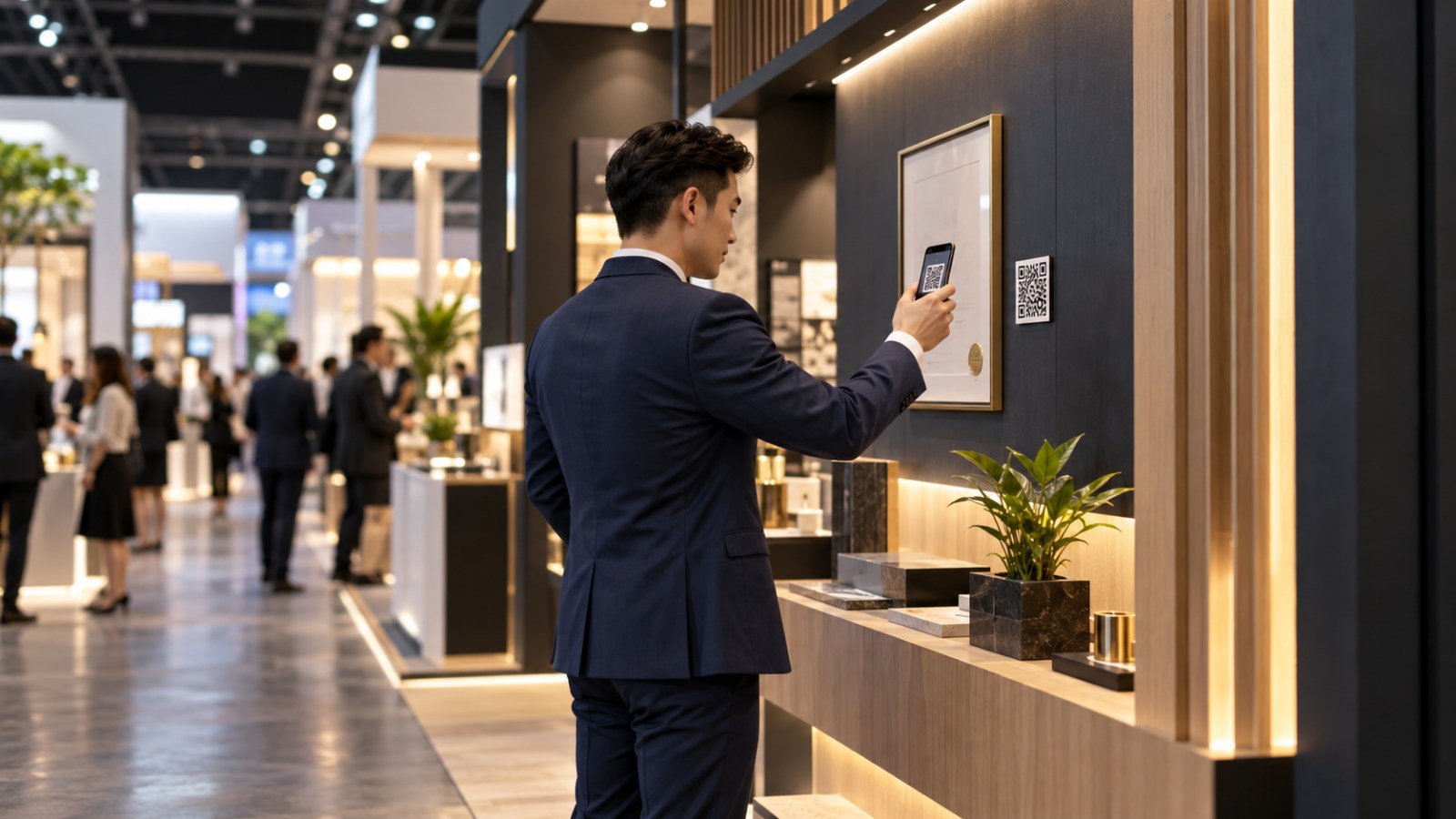
- Add a verification route. A small QR code beside each certificate or recognition, linking to the issuer’s own listing, turns a display into evidence.
- Keep dates visible. An expired certificate or an award from many years ago signals neglect rather than achievement.
- Separate compliance from distinction. Regulatory approvals and accreditations show that a product is permitted and safe. Awards and recognitions show that a company stands out. Buyers need both, and they should never be confused.
- Remove anything staff cannot explain. If a visitor asks about a badge and nobody at the booth knows what it means, it costs credibility rather than adding it.
Where Independently Recognised Achievements Fit
Some companies have achieved something that goes beyond meeting a standard: a production volume, a service milestone, a first-of-its-kind development or a record-scale result. At an exhibition, an achievement like this can serve as the single specific fact that wins the aisle glance. It is only persuasive if a buyer can confirm it.
This is where independent recognition becomes useful. Platforms such as Asia Record document measurable achievements by businesses, organisations and individuals across the region. Under its published verification process, a proposed record must state exactly what is being recognised and how success is measured. It is then assessed against submitted evidence for consistency, measurability and verifiability before an outcome is communicated. For an exhibitor, that structure matters more than the trophy. It means the achievement has a defined claim, a defined measure and a public reference point.
For an Asia Record holder, the practical step is to treat the recognition like any other credential on the booth wall. Display the exact record title rather than a paraphrase. State the year. Link to the corresponding listing in the Asia Record official Record Holder directory so visitors can check it themselves. The same discipline applies to business awards in Asia: name the organiser, category and year, and make the published result easy to find.
Two cautions apply. First, record recognition documents an achievement. It does not replace product certification, regulatory approval, halal certification, accreditation or legal compliance, and booth messaging should never imply that it does. Second, timing matters. Companies wondering how to get an Asia Record ahead of a specific exhibition should start early. An Asia Record application requires a proposed title, a measurement method, dates, locations and supporting evidence, and assessment time depends on how complete and complex the submission is. Those planning to apply for Asia Record recognition should confirm current requirements directly with the organisation rather than assume a fixed timeline.
Handled this way, recognition of Asian business achievements becomes part of a wider credibility system rather than a decoration. It also gives the company something concrete to announce without sounding like a brag in the weeks before the show.
Common Mistakes Asian Exhibitors Make
- Designing the booth before deciding the message. Many companies brief the booth builder first and only then ask what the booth should say. The order should be reversed.
- Translating claims without checking them. At multilingual fairs, a claim that is accurate in English can become an overstatement in Bahasa, Thai, Vietnamese or Chinese. Every language version should be reviewed against the evidence.
- Displaying customer logos without permission. This is common and risky. A buyer who recognises their own company’s logo on a stranger’s booth will remember it for the wrong reason.
- Letting staff improvise numbers. When one salesperson says 300 clients and another says 500, the visitor believes neither.
- Using superlatives no one can verify. Words like “Asia’s No.1” or “the region’s largest” invite exactly the scrutiny that unprepared exhibitors cannot withstand.
- Forgetting the website. If the booth promotes a recognition that appears nowhere on the company’s site, the follow-up desk review will raise doubts.
A Pre-Show Credibility Checklist
- List every claim that will appear on the booth, in printed materials and in staff scripts.
- Match each claim to a specific source of proof, and remove or rewrite any claim without one.
- Confirm that every certificate is current and every award or recognition shows its year and issuer.
- Add QR codes linking to third-party verification pages wherever possible.
- Obtain written permission for every customer name or logo on display.
- Brief all booth staff on the approved figures, and on what to say when they do not know an answer.
- Check that the company website, LinkedIn page and any corporate proof page match what the booth says.
- Review all translated materials for accuracy against the original evidence.
- Prepare a short follow-up pack that buyers can forward internally, with sources included.
Frequently Asked Questions
Does a booth need awards or recognitions to be credible?
No. Many credible exhibitors display none. Specific facts, named customers, live demonstrations and current certifications can carry a booth on their own. Recognition is useful when it confirms a genuinely distinctive achievement, but it should support the message rather than replace it.
Is record recognition the same as Asia record certification of a product?
No. Although many people search for the term Asia record certification, record recognition confirms that a defined, measurable achievement was assessed and recognised. It does not certify that a product meets safety, quality or regulatory standards. Those require the relevant certification bodies and authorities.
How should a company display a recognised achievement at an exhibition?
Use the exact title as recognised, include the year, name the recognising organisation and give visitors a way to verify it, such as a QR code to the official listing. Make sure staff can explain what was measured and how.
The Booth Is a Promise. The Proof Is What Buyers Remember.
Trade show branding in Asia is often treated as a design challenge: brighter lighting, bigger screens, a more striking structure. Those things help visitors notice a booth. They do not help visitors believe it. In crowded halls full of identical claims, the exhibitors who stand out are the ones who make verification effortless, from the aisle glance to the booth conversation to the buyer’s desk review a week later.
The work happens before the show opens. Audit the claims, gather the evidence, display only what can be checked and make sure every channel tells the same story. Do that, and the booth becomes more than a marketing expense. It becomes a place where trust starts.
Digital Business
Companies with strong digital platforms can scale faster and reach new customers more efficiently.
Sustainable Growth
Responsible business practices help brands build credibility with investors and consumers.